
Surnames rarely emerge from thin air; they are living monuments anchored to physical ground. In the case of the family name Mergener, the thread leads back through layers of Moselle Valley history—from modern genealogical lines back through medieval Benedictine vineyard stewards, early Christian martyr shrines, and Gallo-Roman burial grounds, straight to the Iron Age Celtic tribe that gave Trier its very name: the Treveri.
Is it possible to trace a continuous line spanning two and a half millennia between the original "people of the valley" and those who carry the Mergener name today? When evaluated through geography, linguistics, and archaeology, the evidence demonstrates an unbroken chain of human presence along the exact same riverbanks.
The Spot:"The Abbey of St. Mergen (St. Maria ad Martyres) sat on the right (northern) bank of the Moselle River, roughly one mile downstream (northwest) from Trier’s famous Roman gate, the Porta Nigra. Positioned just outside the ancient northern city walls, it occupied the narrow, fertile strip of flatland where the valley floor meets the river’s edge—directly opposite the high sandstone cliffs of Zurlauben and at the base of the steep vineyard slopes leading up into the Eifel hills."
1. The Original Valley Folk: Celtic Treveri to Gallo-Romans (500 BC – 400 AD)
Around 500 BC, the Moselle River corridor was controlled by the Treveri, a skilled Celtic tribe renowned for their master horsemanship, ironworking, and command over strategic river crossings. The name Treveri itself is derived by linguists from roots meaning "the river-crossers" or "way-finders," pointing directly to their mastery over the natural ford along the Moselle at modern Trier.
When Julius Caesar’s legions conquered Gaul in the 50s BC, the Romans did not displace or eradicate the local Treveran population. Instead, they built their regional capital—Augusta Treverorum (Trier)—directly in the Treveran heartland. The native Celtic elite and agricultural workforce integrated into Roman society, becoming Gallo-Romans. They kept their equestrian traditions, cultivated the initial steep-slope vineyards, and buried their dead in extensive cemeteries established outside the northern city walls along the river road.
2. Sacred Continuity: Late Roman Burial Grounds to St. Mergen (400 AD – 1500 AD)
As Christianity spread throughout the late Roman Empire in the 4th century, the Gallo-Roman population of Trier began erecting memorial chapels (martyria) over the graves of early local martyrs and believers buried along the northern riverbank cemetery.
This early Christian burial site evolved directly into the imperial Benedictine abbey known officially in Latin as Sancta Maria ad Martyres ("St. Mary at the Martyrs"). Over a thousand years of continuous monastic life, the abbey acquired vast holdings—including prestige vineyard terraces such as Scharzhofberg—and served as a major center for imperial hospitality and trade along the Moselle.
The Phonetic Engine: How Marian Titles Became Dialect
While monastic scribes recorded official transactions in formal Latin using genitive inflections like Mariae (e.g., Monasterium Sanctae Mariae ad Martyres) and German imperial administrators later adopted St. Marien am Ufer, but the everyday people living and working along the river spoke Moselle Franconian.
Over centuries of regional speech, the Middle High German Sante Merien naturally contracted into the localized dialect form: St. Mergen
3. Toponymic Lineage: From Abbey Lands to the Surname Mergener (1400 AD – Present)
During the late Middle Ages (14th to 16th centuries), as fixed hereditary family names stabilized across the Rhineland, individuals were regularly identified by their relationship to the landscape, estates, or institutions where they lived and worked.
Tenant farmers, vineyard managers, rivermen, and stewards attached to the domain of St. Mergen received the locative identifier Mergener—literally meaning "one belonging to or coming from St. Mergen." Just as the name of the city of Trier preserves the identity of the Celtic Treveri, the family name Mergener preserves the exact phonetic mark of that specific stretch of the Moselle riverbank.
Historical Synthesis: Evaluating the Lineage
Connecting Iron Age tribes to modern family names requires examining multiple lines of historical proof. The structural links of this 2,500-year chain evaluate as follows:
| Historical Dimension | Continuity Focus | Analytical Foundation |
|---|---|---|
| Spatial & Topographical | 10 / 10 | Unbroken human utilization of the exact same northern riverbank, ford, and vineyard terraces in Trier from 500 BC to modern times. |
| Linguistic & Etymological | 10 / 10 | Direct lineage from Latin Mariae through Moselle Franconian dialect contraction St. Mergen to the locative surname Mergener. |
| Institutional & Sacred | 9 / 10 | Direct physical transition from Celtic river settlement -> Gallo-Roman necropolis -> Early Christian martyrium -> Medieval Benedictine Abbey -> Secular Estate (*Mergener Hof*). |
| Population Stability | 8 / 10 | Regional archaeological and demographic studies show high long-term stability among the agrarian and viticultural populations of the Moselle/Eifel region across major historical transitions. |
Why the St. Mergen Story Was Lost to English History
If you search English-language encyclopedias, academic journals, or mainstream genealogical databases for the Abbey of St. Mergen or the Mergener Hof, you will meet an almost total silence. While German municipal archives, local historical societies, and regional research papers in Trier contain rich documentation on the abbey and its urban estates, the story completely vanished from the English-speaking world.
This disappearance was not an accident, nor was it caused by secret family shame. Emigrants did not bury their past because they were cast out in disgrace; they left as legally cleared, tax-paying families seeking economic survival. The erasure of this 2,000-year history from English records is the result of four specific historical and cultural shifts:
1. The Abbey Was Destroyed Decades Before Emigration
When the primary wave of Mergener families departed the Moselle Valley for the United States in the 1850s, the physical Abbey of St. Maria ad Martyres (St. Mergen) no longer existed. In 1794, French Revolutionary forces occupied the Rhineland. By 1802, under Napoleonic decrees, the monastery was secularized, its monks dispersed, and its ancient stone structures auctioned off, repurposed, or demolished. To our 19th-century ancestors, "St. Mergen" was no longer an active Benedictine monastery—it was a cherished geographic origin, a parish memory, and their family name.
2. Rapid American Assimilation and Dialect Loss
Upon arriving in North America or South America, pioneer families faced immediate pressures to integrate. Within two generations, spoken Moselfränkisch (the regional Moselle Frankish dialect) gave way to English or Portugues in public schools and daily commerce. To 19th-century American land clerks, census takers, and neighbors, "Mergener" was merely an obscure, hard-to-pronounce German surname. The intricate local history of Trier—the distinction between a Latin abbey name, a local dialect pronunciation, and a medieval urban Stadthof—held little practical utility on the American frontier.
3. The Anglo-American Academic Barrier
Monastic administrative history in the Rhineland is intensely hyper-local. For over two centuries, German archivists and historians at the Stadtarchiv Trier have studied Latin land deeds, feudal tithe registers, and medieval municipal boundaries. Because these specialized studies were published exclusively in German academic literature, they were never translated into English. Unless an abbey featured prominently in major international conflicts like the Crusades, regional monastic histories rarely crossed the language barrier into English scholarship.
4. A Living Badge of Survival
Far from carrying shame, carrying the name Mergener was an act of quiet resilience. The physical abbey was leveled by war and politics, its institutional power dissolved, and its stones scattered. Yet the families who tilled its soil and worked its vineyards carried the name across the Atlantic Ocean, preserving the memory of the ancient sanctuary long after its walls had fallen.
Restoring the Bridge at Mergener.org
Mergener.org exists to close this two-century research gap. By translating regional German municipal archives, digitizing medieval property rolls, and connecting old-world geography with living global descendants, this archive brings the forgotten history of St. Mergen into the English-speaking world for the first time.
Conclusion
The line drawn from the Treveri through Roman Trier and the Abbey of St. Maria ad Martyres to the Mergener family is grounded in the geography and language of the Moselle Valley. Rather than a mere coincidence of spelling, the surname Mergener represents a 2,500-year narrative of place—a direct link to the enduring "people of the valley."
Want to dive deeper into the mysteries of Mergener and the People of the Valley?
Tracing the Mergener Family NameSt Mergen 1300 Year Epic
Poppo von Babenberg to the rescue
St Mergen - the Land and the Name
What was rescued and how it was turned into Wealth
Parodox of Benedictine and Machiavelli
Creation and Use of Wealth and Power
The Gardens of St Mergen
From Medieval Abbey to Mergener Hof
So now your a Mergener
Are You A Mergener?
Etymology of the Mergener Name
The Monastic Origins of Mergener
Broken Cloister of St Mergen
Managing an Empire
Parodox of Benedictine and Machiavelli
Governance & Life at St. Mergen Benedictine Abbey
St Mergen Partnership the Ink and the Oar
The Moselle Paradox Marx and Mergener
Let's make a Documentary
Your personal Mergener story starts at the end of this one ...The 2500 Year Mergener Chronicle - Book One The Severed Root
Still want more? I publish additional notes on my blog
Establishing Mergener as a Surname
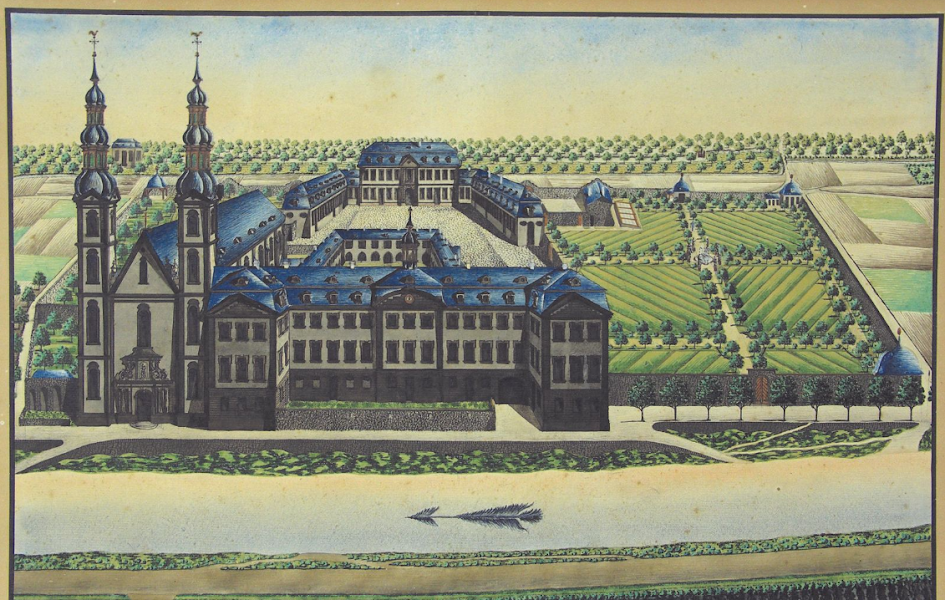
St Mergen
1794 painting of the Abbey of St Mary of the Martyrs by the master architect-artist Johann Jakob Lothary
Located at the City Museum Simeonstift Trier - Simeonstraße 60, 54290 Trier, Germany (next to Porta Nigra)